
WMS & Inventory Management Implementation

WMS & Inventory Management Implementation
If you cannot see your inventory in real time, you are making decisions blind.
Managing inventory across multiple locations with different product lines, compliance requirements, and customer commitments requires more than a spreadsheet. The cost of stock errors, misplaced inventory, and manual audit cycles compounds faster than most organisations realise.
We implement AI-powered Warehouse Management Systems that give you complete real-time visibility across every location, every SKU, and every movement, with the intelligence to optimise placement, flag anomalies, and automate reconciliation.
What This Includes
Real-time inventory tracking across multiple sites
AI-driven SKU identification and placement optimisation via computer vision
Barcode and QR scanning at pallet, SKU, and delivery level
Automated cycle counting and audit triggers
Returns, purchasing, and outbound logistics management in one platform
ERP, CRM, and delivery API integration
KPI dashboards and exportable reporting for operations and finance teams
Case Study
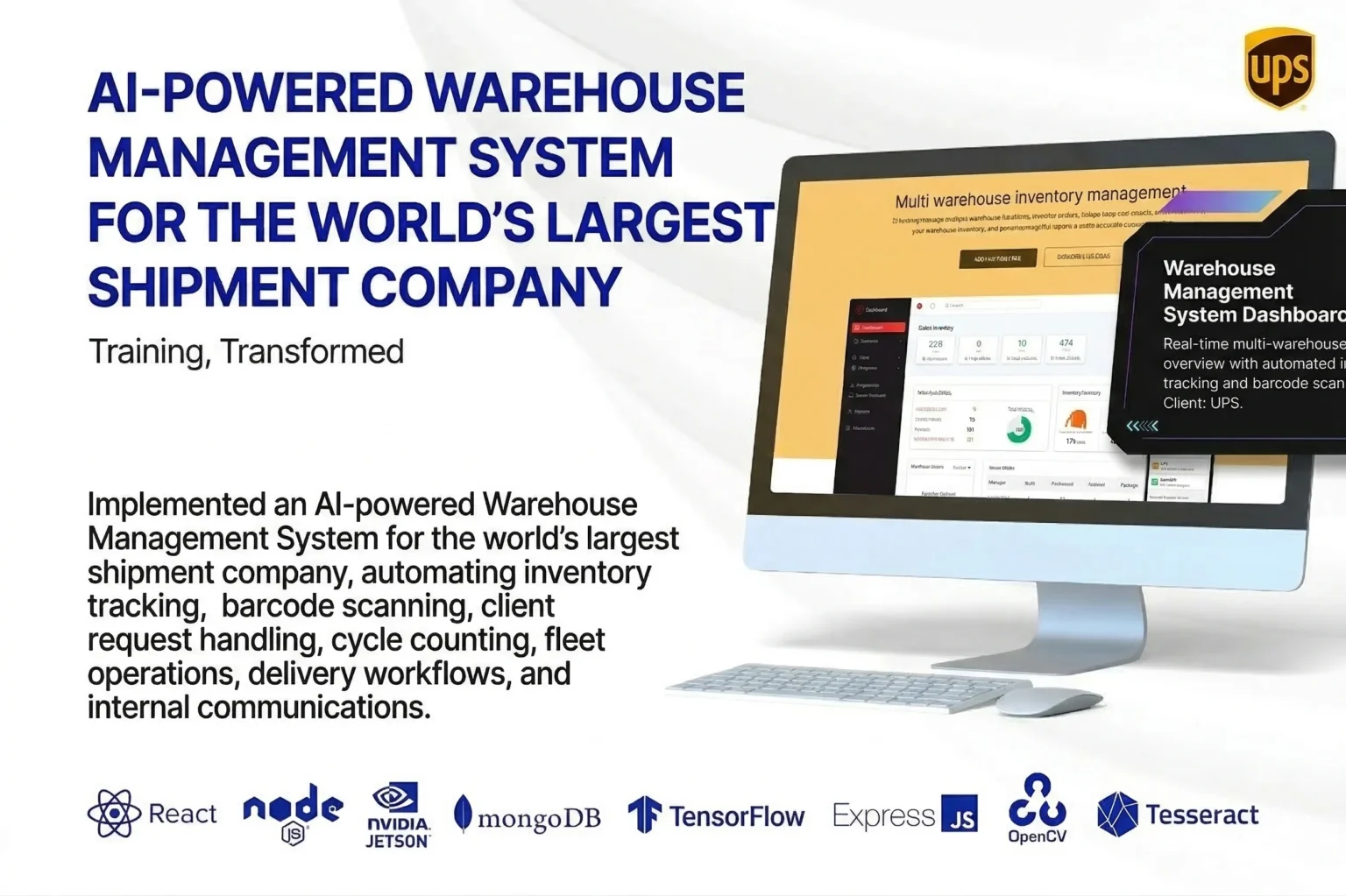
AI-Driven Warehouse Management System
UPS was managing a global warehouse network with fragmented tools, manual inventory tracking, limited real-time visibility across locations, and rising operational costs from errors and rework across delivery, returns, and stock management workflows.
- 90% increase in real-time warehouse visibility
- 40% boost in ground team efficiency
- 30% improvement in customer satisfaction
- Significantly reduced mismatch rates and audit errors
- Improved inventory accuracy and cost efficiency across all locations



FAQs
What kind of results can we expect from an AI-powered WMS?
Our UPS implementation delivered a 90% increase in real-time warehouse visibility and a 40% boost in ground team efficiency. Results vary by operation size and starting point, but the case study on this page reflects a real, measured deployment, not a projection.
Can the WMS integrate with our existing ERP and delivery systems?
Yes. ERP, CRM, and delivery API integration is a core part of the implementation, so the WMS works alongside your existing systems rather than becoming an isolated tool your team has to check separately.
How does computer vision improve SKU accuracy?
Computer vision is used for AI-driven SKU identification and placement optimisation, reducing the manual scanning and matching errors that typically cause mismatch rates and failed audits in multi-site inventory operations.
Is this suited to multi-location operations or only single warehouses?
It is built specifically for multi-site operations. Real-time tracking across multiple locations, with KPI dashboards and reporting that roll up across sites, is a standard part of the platform, not an add-on.
Ready to Talk WMS & Inventory Management Implementation
Reach out through Adroit’s existing contact channels. Our team will route this enquiry directly to Nyx Wolves.